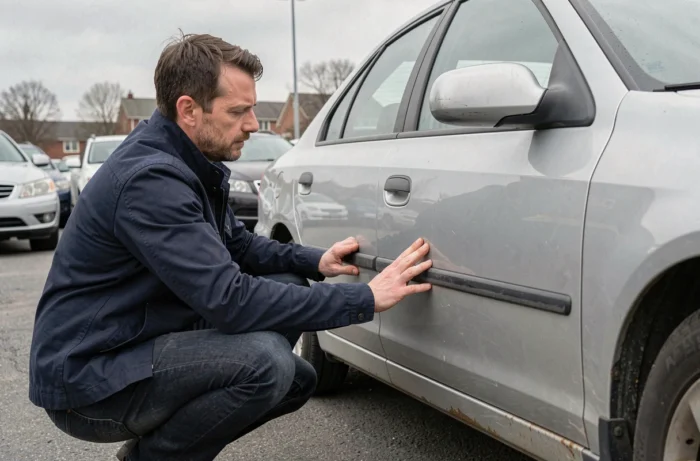
A used car changes hands on average several times during its life. Each transaction also transfers the defects that the previous owner may have concealed, ignored, or simply not detected. Before signing a purchase of a used vehicle, the inspection is not limited to turning the ignition key and listening to the engine: it starts well before, with documents that many potential buyers do not take the time to read.
CO₂ penalty and depreciation: a criterion often overlooked
Traditional buying guides detail the mechanical condition, bodywork, and technical inspection. Very few address the fiscal impact of the chosen model on its future resale value.
The tightening of the CO₂ penalty on new vehicles (threshold lowered to 113 g CO₂/km in the WLTP cycle since the 2025 finance law) has mechanically made high-emission thermal models more difficult to resell. A high-displacement diesel SUV, for example, is now negotiated with an accelerated depreciation, not because it drives worse, but because the market anticipates a continuous tightening of the scale.
For a used car already registered in France, no new penalty applies at the time of resale: the scale used remains that of the first registration, with deductions related to age. This reassures the immediate buyer, but it does not protect against the loss of value at the next resale.
Before signing, checking the CO₂ emissions listed on the registration certificate allows for estimating how easily the vehicle can be resold in a few years. This is as concrete a piece of data as the mileage. Regarding payment security, some buyers prefer to go through the transfer with CapCar on WD Car to avoid bank check fraud, a real risk in transactions between individuals.

Documents of the used vehicle: what to read, not just request
Requesting the registration certificate, maintenance log, and technical inspection report is a well-known reflex. The real challenge is knowing what to look for.
Registration certificate and HistoVec report
The registration certificate (carte grise) must match the identity of the seller. Any discrepancy (different name, inconsistent address) requires a documented explanation. The public service HistoVec allows for cross-referencing this information: changes of ownership, declared accidents that led to a procedure, existence of a lien or opposition.
A seller who refuses to provide the HistoVec report sends a clear signal. This document is free and accessible in a few minutes.
Maintenance log and invoices
A maintenance log stamped by a professional remains the best proof of regular follow-up. Invoices complete the picture by specifying the replaced parts and the intervals between each intervention.
- Check that the stamps in the log correspond to identifiable garages (name, address, SIRET number)
- Compare the revision dates with the recorded mileage: an abnormal discrepancy may indicate a modified odometer
- Ensure that major operations (timing belt, clutch) have been performed within the intervals prescribed by the manufacturer
A blank or incomplete log does not necessarily mean poor maintenance, but it prevents any verification. The risk then rests entirely on the buyer.
Mechanical condition and road test: points that the eye alone cannot detect
A visual inspection of the bodywork identifies obvious dents. The actual mechanical condition requires a more methodical examination.
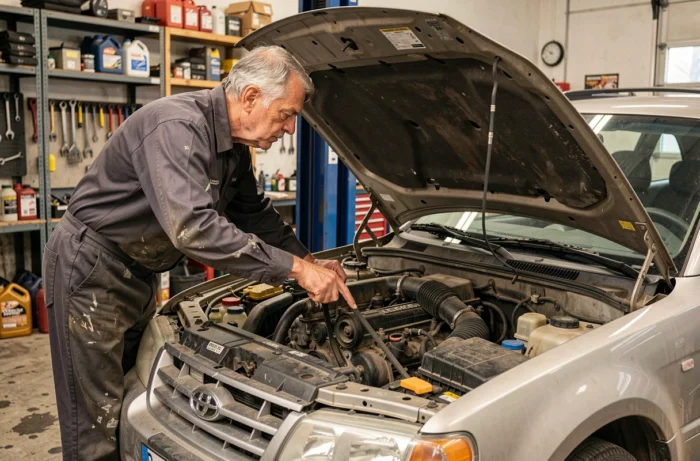
Under the hood: concrete clues
Engine cold, open the hood before starting. An engine already warm at the time of the visit may mask starting difficulties. Observe the following points:
- Level and color of the engine oil: black and thick oil indicates delayed maintenance, milky oil may signal a failing head gasket
- Condition of visible hoses and belts: cracks, splits, or signs of leakage around the connections
- Coolant: correct level and absence of oily deposits on the surface
- Battery terminals: excessive oxidation or signs of recent replacement without associated invoice
These checks take a few minutes. They do not replace an electronic diagnosis, but they allow for ruling out a vehicle whose basic maintenance has been neglected.
The road test: beyond a trip around the block
A useful road test lasts at least twenty minutes and includes several driving conditions: city, highway, hard acceleration, firm braking.
Listening to the engine cold during the first minutes reveals any knocking or whistling sounds. The steering should respond without excessive play or vibration in the steering wheel. Gear shifting (manual or automatic) should not produce any abnormal jolts.
A dull rolling noise at a constant speed often indicates a worn wheel bearing, a repair whose cost may justify a price renegotiation.
Buying an electric used car: the SOH of the battery changes the game
For used electric vehicles, the list of checks expands with a determining parameter: the State of Health (SOH) of the battery. This percentage indicates the residual capacity of the battery compared to its new state.
ADEME is currently leading the harmonization of SOH display by manufacturers and professional sellers, ahead of the arrival of a European battery passport expected in 2027. Several sales platforms already display this data.
A low SOH does not render the vehicle unusable, but it reduces the actual range and may indicate a battery replacement, the cost of which often reaches several thousand euros. Requiring an SOH diagnosis before signing has become as logical as asking for the technical inspection report for a thermal vehicle.
The used car market is evolving rapidly. The criteria that were sufficient a few years ago (mileage, bodywork, engine) no longer cover all risks. Integrating the fiscal, documentary, and technological dimension into each check remains the most reliable way to buy a used vehicle without unpleasant surprises.