
The Eurostar network from Paris is not limited to the connection to London St Pancras. Since the merger with Thalys and the gradual integration of new services, the mapping of direct and indirect routes from Paris-Nord has significantly evolved. We take stock of the operational routes, confirmed extensions, and parameters to watch for planning a trip to the United Kingdom, Belgium, the Netherlands, or Germany.
Direct service to Antwerp from Paris: what changes in December 2026
For a long time, Antwerp was only accessible from Paris with a connection in Brussels-Midi. The commissioning of a direct stop at Antwerpen-Centraal on December 14, 2026 changes the game. This is not a new line, but an addition of a commercial stop on the Paris-Amsterdam route, which implies a marginal extension of the total travel time to Rotterdam and Amsterdam.
For travelers targeting Antwerp, the gain is clear: elimination of the transfer in Brussels and the need to use Belgian IC trains. However, those aiming for Amsterdam will need to check whether their train makes this additional stop, as not all services are affected.
A map of Eurostar destinations from Paris allows you to visualize this network and quickly identify direct connections compared to routes with transfers.
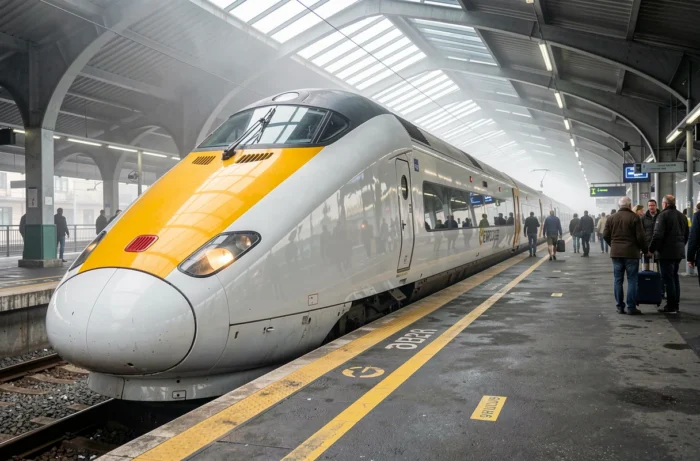
Eurostar Paris-Amsterdam connection: current state of the service
The Paris-Amsterdam line has experienced recurring disruptions, particularly related to construction at Amsterdam Centraal. The service has been restored with up to five daily departures on this route, according to travel summaries published in the summer of 2026. This return to full service changes the perception of reliability of the connection.
A rarely mentioned technical point: border control for trips to the Netherlands takes place at departure, at Paris-Nord. The process differs from that applied to cross-Channel trains, where checks include passing through British checkpoints. Towards Amsterdam, the procedure is smoother, without a dedicated arrival area.
Rotterdam as a tactical alternative
Rotterdam, served before Amsterdam on the same route, offers a significantly shorter travel time. For travelers whose final destination is in southern Netherlands, getting off in Rotterdam and using the NS (Nederlandse Spoorwegen) network can be quicker than a direct trip to Amsterdam followed by a return.
Cross-Channel competition and its impact on the Eurostar network to London
The Office of Rail and Road in the UK granted on August 17, 2026, a pre-authorization to Virgin Trains to operate up to 20 daily round trips via the Channel Tunnel, with a launch planned for October 2030. This decision does not change the current service but signals a structural change in the medium term on the Paris-London corridor.
For Eurostar, the likely consequences are twofold:
- Price pressure on Paris-London tickets, which are currently operated as a de facto monopoly on cross-Channel rail
- A possible redeployment of trains to continental routes (Brussels, Cologne, Amsterdam) where demand is growing without comparable direct rail competition
- An acceleration of investments in onboard services and frequency to maintain market share against an operator promising a differentiated positioning
We recommend monitoring Eurostar’s announcements regarding its 2027-2028 schedules, which will likely reflect the first strategic adjustments in response to this regulatory green light.

SNCF TGV Inoui connections and network from the provinces
The map of Eurostar destinations from Paris is not only for Parisians. Eurostar offers the booking of connecting journeys with TGV Inoui directly on its website, allowing departures from Lyon, Marseille, Bordeaux, or Lille with a single ticket and a connection guarantee.
The critical point remains the layover time at Paris-Nord. Connections sold by Eurostar generally include a calibrated interval, but in case of delay of the approaching TGV, the guarantee does not systematically cover rebooking on the next train under the same fare conditions. It is necessary to check the specific conditions at the time of booking.
Cologne and beyond: the limits of the direct network
Cologne (Köln Hbf) remains the furthest German destination served directly from Paris, via Brussels and Liège. Beyond that, to Frankfurt or Berlin, the transfer is made by Deutsche Bahn’s ICE trains, without a systematic combined ticket on the Eurostar side. Travelers planning a Paris-Berlin trip by train must therefore accept a two-step reservation and a change of station in Cologne.
Other operators, such as GoVolta, have announced ambitions on complementary routes (Cologne, Luxembourg, Strasbourg), but no confirmed service date allows for their integration into concrete planning at this stage.
Choosing your Eurostar ticket: pricing points to watch
Eurostar fares operate on a yield management system comparable to that of airlines. A few parameters deserve attention:
- The cheapest tickets to London or Amsterdam are non-exchangeable and non-refundable, a point often underestimated compared to TGV Inoui habits
- Journeys with intermediate stops (Brussels, Lille) are not always cheaper than direct ones, as pricing depends on the booking class and not on distance
- Simultaneous booking of a round trip does not guarantee a lower fare than two one-way tickets purchased separately, contrary to what the booking interface suggests
Systematically comparing the price of one-way and round-trip tickets remains the most reliable method to optimize the budget, particularly on high-demand routes like Paris-London.
The Eurostar network from Paris now covers five countries with direct connections, and more with transfers. The scheduled arrival of the Antwerp service and the prospect of cross-Channel competition by 2030 are gradually reshaping the offer. The map of destinations is no longer static: it evolves with each seasonal schedule reshuffle.