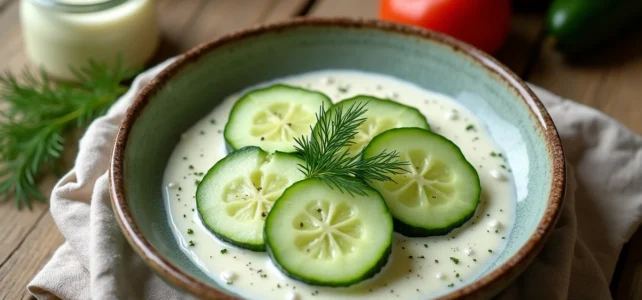
The cucumber with cream appears on the menu of most French brasseries, in school cafeterias, and on family tables as soon as the first warm days arrive. This omnipresence raises a rarely asked question: how has such a basic preparation (a raw vegetable, a dairy product, an acidic seasoning) acquired classic status, while dozens of other raw vegetables have never progressed beyond the stage of a regional dish?
Cucumber with cream and tomato salad: two French trajectories to compare
Comparing cucumber with cream to other cold starters in the French repertoire helps to pinpoint what distinguishes this dish. Three criteria structure the comparison: seasonality, technical simplicity, and adaptability to current food trends.
| Criterion | Cucumber with cream | Tomato salad | Grated carrots |
|---|---|---|---|
| Main season | Spring-summer | Summer only | All year round |
| Preparation time | Less than ten minutes (excluding draining) | Less than five minutes | Less than ten minutes |
| Dairy base | Fresh cream, yogurt, or soft cheese | None (vinaigrette) | None (vinaigrette) |
| Dairy-free variants | Plant-based yogurt, soy-sesame sauce | Not applicable | Not applicable |
| Recent repositioning | Heatwave dish, lighter versions | Focus on heirloom varieties | Stable, little renewal |
The cucumber with cream column reveals a distinctive trait: the dairy base opens up a field of variation that vinaigrettes do not allow. It is this plasticity that explains part of the dish’s longevity.
To better understand the origin of cucumber with cream on La Cuisine de Watoote, we must go back to the role of cucumber in French gardens long before dairy industrialization.

Draining cucumber with salt: the technical gesture that fixed the recipe
Many raw vegetable recipes boil down to cutting and seasoning. Cucumber with cream imposes an additional step: draining the slices with salt for about twenty minutes. This gesture removes excess water from the vegetable and prevents the cream from diluting on the plate.
This technical constraint has paradoxically reinforced the dish’s status. A poorly drained cucumber produces a watery and bland sauce. The draining technique has created a clear boundary between a successful result and a failed one, prompting cooks to pass on the method with precision.
Impact on texture and seasoning
The drained cucumber absorbs cream and vinegar better. The salt alters the cellular structure of the vegetable, making it slightly pliable while retaining crunch. This contrast in texture, between the crisp freshness of the cucumber and the creaminess of the cream, constitutes the sensory spring of the dish.
The classic seasoning relies on an acid-fat balance: white vinegar or lemon juice on one side, thick fresh cream on the other. Chopped chives add a mild onion note that completes this triangle without upsetting the balance.
Recipe for cucumber with cream: from spring dish to heatwave ritual
Several media outlets and French-speaking content creators have redefined cucumber with cream in recent years. The dish is no longer presented solely as a classic spring starter. It is described as a quick anti-heat recipe, associated with repeated summer heatwave episodes.
On Instagram, creators refer to cucumber salad with yogurt as a “summer classic” and “anti-heat recipe.” This shift in positioning, from spring to the heart of summer, has expanded the consumption window of the dish.
Dairy-free variants in recent content
Traditional recipe sites continue to offer the cucumber and fresh cream duo. However, short formats (TikTok, Reels, recent blogs) highlight alternative versions:
- Thick Greek yogurt, which provides a texture similar to cream with less fat
- Light cream cheese, sometimes mixed with lemon and fresh herbs
- Dairy-free seasonings like soy sauce, rice vinegar, and sesame oil, which transform the dish into an Asian-inspired salad
The rise of these plant-based or lighter variants shows that cucumber with cream functions as a framework, not as a fixed recipe. The principle (raw cucumber + creamy binder + acidity) remains stable, but the ingredients shift.

Cucumber in slices or otherwise: the cut changes the dish
The French tradition favors thin slices. Some recent content challenges this reflex. Le Journal des Femmes, for example, suggests that cucumbers in salad are better prepared in ways other than slices.
The cut directly influences the amount of surface area in contact with the cream and salt. Sticks or thick half-moons retain more crunch after draining. Very thin slices become soft faster but absorb seasoning better.
This detail may seem trivial. However, it explains why two versions of the same dish, with identical ingredients, can yield very different results in the mouth. The cut of the cucumber determines the balance between crunch and creaminess.
Three parameters that change the final result
- Thickness of slices: less than two millimeters for a melting texture, three to four millimeters for crunch
- Duration of draining: a short time (ten minutes) retains water in the vegetable, a long time (thirty minutes or more) concentrates the flavors
- Serving temperature: taken out of the refrigerator, the dish offers a maximum freshness that enhances the refreshing sensation
Cucumber with cream did not become a classic by accident. Its minimal structure (vegetable, cream, acid, salt) functions as a framework that each era fills with its own ingredients and dietary concerns. The version with Greek yogurt or soy sauce extends exactly the same logic as the version with fresh cream and chives. It is this adaptability that separates a classic dish from a passing trend.