
A thermal brush cutter remains the default choice for rugged terrain, sloped plots, or dense vegetation that neither a lawn mower nor a trimmer can handle. The market offers dozens of models with similar technical specifications. Before comparing engine displacements or brands, one point deserves attention: the context of use, including regulatory aspects, now weighs as heavily as power in the choice of a machine.
Fire risk and local restrictions: a determining criterion
Engine, weight, cutting system: these characteristics occupy product sheets, but one parameter significantly alters the daily use of a thermal brush cutter: fire risk-related restrictions. Several municipalities and departments now prohibit or limit the use of thermal brush cutting tools during the hottest parts of the day, with varying time slots depending on the region.
This constraint has direct consequences on the choice of equipment. A user located in an area subject to these restrictions will need to concentrate their work in the early morning or evening, which changes the way they plan maintenance of a plot.
Prevention guides also recommend favoring nylon line near rocks and in dry vegetation to limit sparks, and reserving the metal blade for clean areas. This is not a detail: a blade striking a stone can generate a spark capable of smoldering in dry grass for several minutes before igniting.
Recent guidelines emphasize the necessity of staying on-site after use and monitoring hot spots. The comparisons available on top-debroussailleuse-thermique.com allow for cross-referencing the technical characteristics of models with these usage constraints.
Engine displacement and torque: what really matters
The engine displacement is the first figure displayed on all product sheets. It provides an indication of power potential but is not sufficient to distinguish between two machines. What differentiates an effective brush cutter from one that struggles is the torque delivered at the cutting head.
A modestly sized engine that is well coupled at low RPM will tackle thick brambles without stalling. Conversely, a larger engine that delivers its power only at high RPM will tire the user and consume more fuel for a comparable result.
2-stroke or 4-stroke engine: field feedback varies
The 2-stroke engine dominates the thermal brush cutter market. It is lighter, cheaper to produce, and offers a good power-to-weight ratio. The 4-stroke, popularized notably by Honda, consumes less fuel and produces less vibration. However, it is heavier, and its maintenance differs (separate engine oil change).
Field feedback varies on this point. Some regular users prefer the 4-stroke for comfort during long sessions. Others find that the extra weight negates the benefit of reduced vibrations. The choice depends on the average duration of your work sessions: beyond an hour of continuous use, the 4-stroke becomes a measurable advantage in reducing muscle fatigue.
Compatibility of the cutting head: a common pitfall at purchase
The compatibility of the cutting head generates a notable proportion of product returns and frustrations. The cutting head is not universal. Before purchasing a replacement head or accessory, four elements must be checked:
- The thread of the drive shaft (diameter and pitch), which varies by brand and sometimes by ranges within the same manufacturer
- The direction of rotation of the head, which can be clockwise or counterclockwise depending on the model
- The diameter of the attachment on the bevel gear, often expressed in millimeters
- The range of nylon line diameter accepted by the head, which determines its ability to cut through thick vegetation
Mounting an incompatible head is not just a performance issue. A poorly matched thread can damage the shaft or cause detachment during operation, posing a direct risk to the user. Checking these four points before purchase avoids unnecessary expense and real danger.
Harness, handle, and weight: the ergonomics that determine actual use
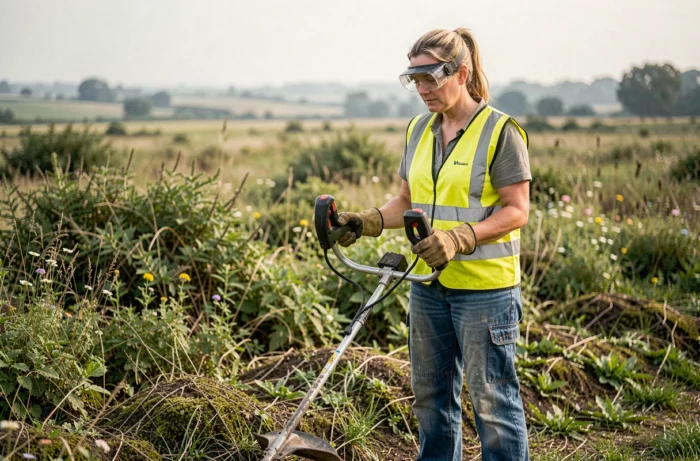
A powerful engine combined with a poor harness results in a machine that is used less and less. Ergonomics dictate the actual frequency of use, making it a criterion as structuring as power.
Thermal brush cutters are divided between two main types of handles. The handlebar (known as “bike”) is suitable for mowing large flat areas. The loop handle offers more maneuverability in rugged terrain, on slopes, or around obstacles.
The harness changes the game for long sessions
A simple shoulder harness is sufficient for short interventions. For regular use on sloped terrain or large areas, a double-strap harness with a lumbar belt distributes the load on the hips rather than the shoulders. Some professional models offer a full forestry harness that stabilizes the machine and reduces lateral jolts.
The weight of the machine loaded with fuel must be evaluated, not just the empty weight indicated on the technical sheet. A full tank can add significant weight, and it is this weight that your shoulders will bear throughout the duration of the work.
Nylon line or metal blade: adapting the cutting tool to the vegetation
The choice of cutting system is not a one-time decision. The same brush cutter can accommodate either nylon line or a blade depending on the work to be done, provided that the bevel gear and engine power allow it.
- The nylon line is suitable for tall grasses, grasses, and edge work. It is more tolerant of obstacles (stones, stumps) and generates fewer sparks in dry terrain
- The two or three-tooth blade tackles brambles, young woody shoots, and semi-shrub vegetation. It requires a clear terrain free of any hard obstacles
- The multi-tooth or tungsten blade is reserved for heavy brush clearing work, on stems of larger diameter
Switching from one tool to another takes a few minutes on most machines, provided that the compatibility of the head has been checked (see previous section). Adapting the cutting system to the season and type of vegetation extends the machine’s lifespan and reduces fuel consumption.
Local restrictions, compatibility of cutting accessories, and harness ergonomics: these three checks before purchase remain the most reliable approach to avoid a machine that will end up at the back of the garage after two uses.