
The Rennes ring road experiences daily slowdowns that turn journeys of a few kilometers into trips lasting several tens of minutes. Since the start of the 2026 school year, several measures have concretely changed traffic conditions in the metropolitan area, including traffic light access regulation, enhanced public transport, and nighttime renovation works on the northwestern part of the ring road.
Waze Effect on the Peripheral Municipalities of Rennes: An Underestimated Problem
When the N137 or the southern ring road becomes congested, navigation apps redirect hundreds of vehicles to roads that were not designed for such volume. The RD 82 in Noyal-Châtillon-sur-Seiche is the most documented example: this five-kilometer departmental road, parallel to the N137, becomes clogged as soon as an incident blocks the Nantes-Rennes axis.
The problem goes beyond mere inconvenience. Residents suffer from increased pollution, noise disturbances, and road safety issues on narrow roads without sidewalks or cycling facilities. Field reports vary on the actual extent of the phenomenon: some local officials speak of continuous queues during peak hours, while others downplay it by pointing out that traffic quickly subsides once the incident is resolved on the main axis.
For motorists following these detour routes, the time savings are often illusory. The detour increases the distance, and the congestion simply shifts from one axis to another. Checking the conditions of traffic jams and circulation in Rennes today before leaving remains more reliable than blindly following a real-time route recalculation.
Traffic Lights on the Rennes Ring Road: What the Initial Results Show
Since the experiment launched in September 2023 at the Bréquigny gate, Rennes Métropole has installed traffic lights on the access ramps to regulate the incoming flow onto the ring road. The principle is simple: instead of allowing all vehicles to merge simultaneously, the light releases them in short waves.
The data collected in the Bréquigny area indicate two concrete results. In the morning, traffic is more consistent, with better distribution. In the evening, the formation of traffic jams is delayed by 12 minutes. This delay may seem modest, but during a peak period lasting about an hour, it represents a significant reduction in the time spent at a standstill.
The system is now being extended to four new ramps. The available data does not yet allow for conclusions about the overall effect across the entire ring road, as each ramp has different traffic characteristics. However, the mechanism has a predictable side effect: queues form upstream of the traffic light, on the access roads, which can create backup towards adjacent roundabouts.
Modal Alternatives in Rennes: Metro, Bus, and TER in September 2026
Avoiding traffic jams is not limited to choosing a better driving route. Changes to the STAR network at the start of the 2026 school year alter the equation for several types of trips.
- Metro open from 6 AM on Sundays, a new feature that eliminates the mandatory use of a car for weekend morning travel, whether for work shifts or leisure
- Request stops after 9 PM on buses, making late-night public transport returns more flexible and reducing waiting times at less frequented stops in the evening
- Covoit’Star free during the month of September, a one-time operation aimed at shifting some home-to-work trips from solo driving to organized carpooling
On the rail side, the Brittany Region has increased the frequency of TER services on the Rennes-Saint-Malo, Rennes-Redon, and Rennes-Vitré routes. For users coming from the wider metropolitan area, these enhanced connections provide a direct alternative to peak times on the ring road.
Combining Bike and Train to Bypass the Ring Road
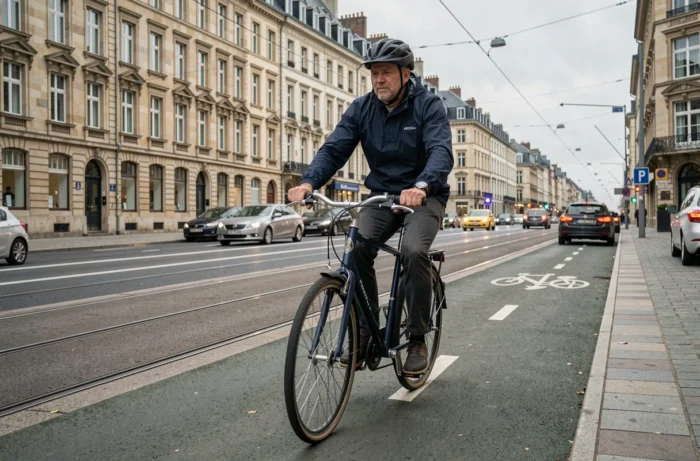
The most effective strategy for suburban trips often combines two modes. A TER trip from a station in the second crown, complemented by a folding bike or a bike stored at the arrival station, allows for completely avoiding the ring road. The Brittany Region has identified this train-bike combination as a priority for the new school year.
Nighttime Works on the Northwestern Ring Road: Anticipating Disruptions
The northwestern part of the Rennes ring road is undergoing renovation with scheduled nighttime closures for nearly a month. These works do not directly affect classic peak hours, but they disrupt nighttime journeys and very early morning departures.
The detours in place redirect traffic to secondary routes that are not designed to handle the usual flow of the ring road. Drivers leaving before 6 AM or returning after 10 PM should check the affected areas before each trip.
A minor incident is enough to paralyze all traffic on a ring road already close to saturation during peak hours. The combination of nighttime works and daytime accidents creates cascading blockage situations that navigation apps struggle to anticipate, as they react to real-time traffic rather than structural conditions.
Traffic in Rennes is not just a binary choice between “leaving earlier” and “taking another route.” The traffic lights show measurable results in specific areas, public transport is gaining extended hours, and carpooling benefits from a free window. Each trip deserves a mode-by-mode evaluation rather than an automatic driving reflex, especially as renovation works redistribute flows on the ring road.