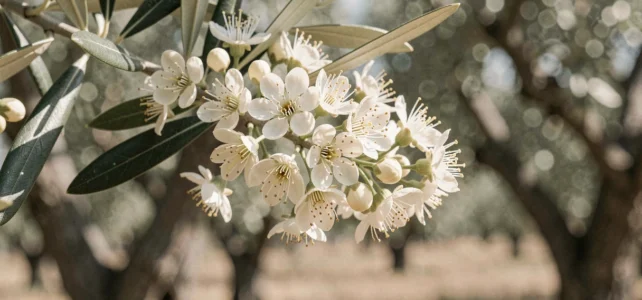
The small white flowers that appear on olive trees between May and June often go unnoticed. They are discreet, clustered tightly along the branches, and their blooming lasts only about fifteen days. This brevity conceals a much larger ecological role than one might imagine, particularly for bees and all the pollinators that revolve around olive groves.
Olive Pollen and Bees: An Underestimated Food Resource
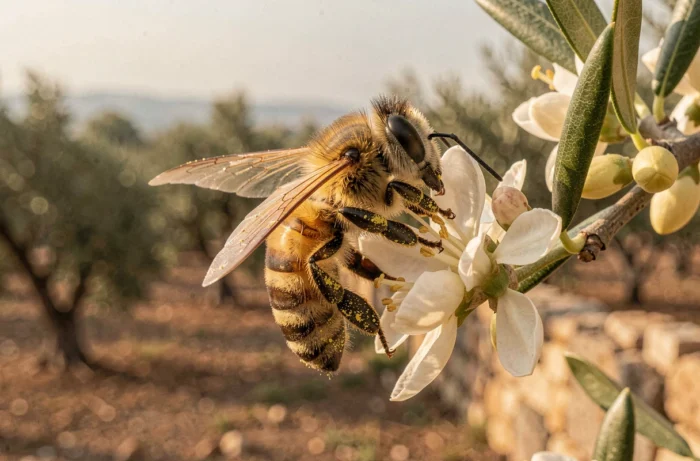
The olive tree is primarily anemophilous: its pollen travels by wind. This characteristic has long led to minimizing the interest of its flowers for insects. Bees do not come to seek nectar in large quantities, but they actively collect pollen to feed their larvae.
This pollen represents a source of protein for bee colonies at a crucial time of the year. By the end of May, spring floral resources begin to decline in many Mediterranean landscapes. Olive trees then take over and provide an additional supply, even though their blooming remains short.
The resulting cross-pollination also benefits the trees themselves. Some varieties of olive trees are not self-fertile and depend on pollen from other cultivars to produce fruit. By moving from flower to flower, bees promote this genetic mixing and improve the fruit set rate, which is the percentage of flowers that actually turn into olives.
To better understand the blooming of olive flowers and their attractiveness to bees, one must look beyond just nectar and consider the entire food chain of the hive.
Traditional or Intensive Olive Groves: A Very Different Impact on Biodiversity
Not all olive groves are equal from an ecological standpoint. Talking about olive flowers and biodiversity without distinguishing between cultivation methods ignores a determining factor.
Research published in 2024 (Tarifa et al.) on intensive Mediterranean olive groves highlighted a marked erosion of pollinator and bird diversity in heavily mechanized and weeded systems. Rare species disappear first, impoverishing the insect community that depends on these orchards.
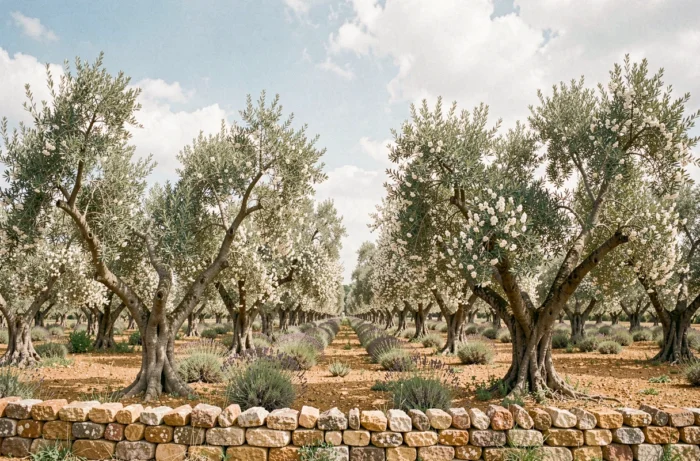
In contrast, traditional olive groves, with their ground cover between rows, stone walls, and hedges, serve as true refuges. They host much more than just honeybees:
- Solitary bees (osmias, andrenids) that nest in the ground or in the cavities of old olive tree trunks
- Syrphids and bumblebees attracted by the herbaceous flora growing under the trees
- Beetles and butterflies that benefit from the plant diversity on the ground
A complementary study (Ruiz-Carrasco et al., Journal of Cleaner Production, 2024) confirms that extensive systems with ground cover maintain significantly higher functional biodiversity. The blooming of the olive tree, in this context, is part of a network of floral resources that extend over several months.
Ground Cover and Bee-Friendly Hedges: Extending Blooming Around the Olive Tree
Have you ever noticed that some olive groves are perfectly bare between the rows, while others resemble meadows? This difference is not cosmetic. Permanent ground cover plays a direct role in the duration of resource availability for pollinators.
Olive flowers provide pollen for about fifteen days. That’s short. For bee colonies and wild pollinators to sustain themselves throughout the year in an orchard, a continuous floral calendar, without periods of scarcity, is necessary. Herbaceous covers (clover, sainfoin, phacelia) and hedges composed of bee-friendly shrubs (rosemary, lavender, strawberry tree) complement the blooming window of the olive tree.
This approach is not just a matter of goodwill. Syntheses on pollinator-friendly practices in European protected areas show that managing vegetation on the ground and at the edges of plots is the most effective lever to support insect populations in orchards.
The Specific Case of Agrovoltaic Olive Groves
Recent studies explore the installation of solar panels above or between rows of olive trees. The result is surprising: partial shading creates a cooler and more humid microclimate at ground level, which promotes the growth of herbaceous plants. These enriched covers attract more pollinators than a conventional orchard exposed to full sun.
This agrovoltaic model, still experimental, illustrates that the question of biodiversity in olive groves goes beyond just the blooming of the tree. It is the entire ecosystem of the orchard that determines its value for bees.
Cross-Pollination and Olive Quality: A Direct Link
Beyond biodiversity, the presence of bees in an olive grove has measurable consequences on production. Cross-pollination improves the quality of the fruits, their size, and the consistency of the harvest.
When a bee carries pollen from one variety of olive tree to another, it stimulates the fertilization of flowers that, without this external input, would have remained sterile. Some cultivars commonly planted in Provence or Languedoc heavily rely on this cross-pollination to produce properly.
The practical consequence is clear: an olive grower who supports pollinators is directly investing in their harvest. Planting pollinator-friendly varieties nearby, maintaining hedges, and avoiding insecticide treatments during blooming are actions that are both agronomic and ecological.
- Associate at least two compatible varieties of olive trees for cross-pollination
- Maintain a flowering ground cover under the trees to attract insects before and after the blooming of the olive tree
- Eliminate phytosanitary treatments during the blooming period, usually between mid-May and mid-June
The blooming of olive flowers, however brief, constitutes a link in a much longer chain. Its value for bees and biodiversity depends less on the tree itself than on the agricultural landscape that surrounds it. A grassy orchard, bordered by hedges, managed without chemical herbicides, transforms fifteen days of pollen into a viable habitat throughout the year.