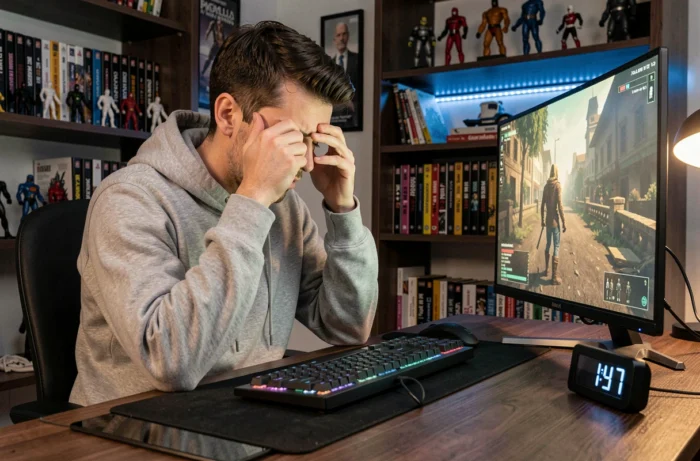
Gaming screens emit a light spectrum that interferes with the production of melatonin, the hormone that regulates the sleep-wake cycle. This physiological mechanism affects all players, regardless of their level or the type of game played. Understanding the workings of this disruption allows for the adoption of concrete habits to protect the quality of one’s nights without giving up on their passion.
Sleep Debt in Gamers: An Underestimated Cumulative Mechanism
Most advice on gamer sleep focuses on the occasional all-nighter. The real problem is more insidious: sleep debt refers to moderate but repeated deprivation, accumulated over several consecutive days.
Specifically, losing an hour of sleep each night for a week results in a deficit comparable to a full night of sleep deprivation. Recent summaries in sports science show that this debt reduces the ability to repeat quick and precise actions, a parameter directly translatable to competitive games that require responses within milliseconds.
The trap is that the initial signs go unnoticed. A decrease in reaction time or difficulty making tactical decisions gradually sets in. A player who simply thinks they are “out of shape” is actually experiencing the effects of accumulated rest deficit. The right strategy is not to sleep twelve hours on the weekend, but to make up for the debt by going to bed earlier several nights in a row, or by taking short naps (less than twenty minutes) in the early afternoon.
Those seeking specialized resources on this topic will find tailored insights for player profiles on Insomnie du Geek, which addresses sleep disorders related to screens and gaming.
Blue Light and Melatonin: What Happens at the Hormonal Level
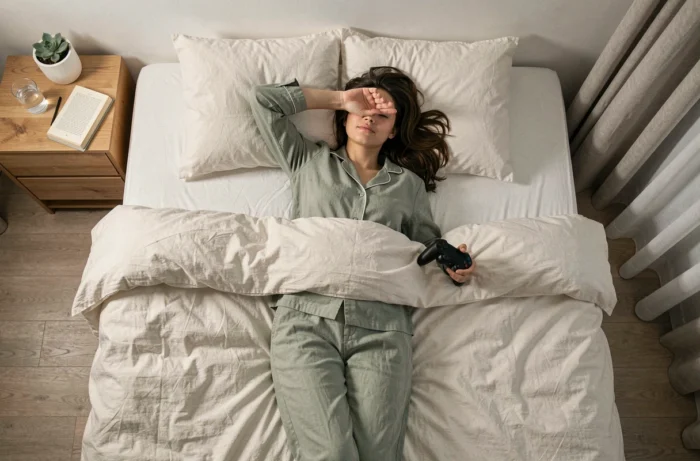
LED screens (monitors, TVs, smartphones) emit light rich in blue wavelengths. The photoreceptors in the retina, sensitive to this spectrum, send a signal to the suprachiasmatic nucleus of the brain, the structure that synchronizes the internal biological clock.
When this light signal arrives in the evening, the brain interprets it as still being daytime and delays the secretion of melatonin. The result: falling asleep is delayed, sometimes by several tens of minutes, even if physical fatigue is present.
Software Filters and Blue Light Blocking Glasses
Filters integrated into operating systems (night mode on Windows, Night Shift on macOS) reduce the blue component of the screen by shifting colors towards warm tones. Their effectiveness depends on the intensity of the applied filter and the duration of residual exposure.
Blue light blocking glasses provide a complementary alternative, especially for players who find that the software filter alters the colors of the game too much. In both cases, activating the filter or wearing the glasses at least an hour before bedtime improves the window for falling asleep.
Bedtime Routine Adapted for Gaming Sessions
The cognitive excitement produced by an intense game does not disappear by simply turning off the screen. Action games, real-time strategy, or ranked online matches trigger a release of dopamine and maintain a high level of alertness long after the session ends.
Building a transition routine between the session and bed is the most effective lever. Here are concrete elements to integrate:
- Finish the session with a calm game (puzzle, management, exploration) rather than a competitive match, to lower the activation level
- Disconnect from all screens at least thirty minutes before bed and fill this interval with a low-stimulation activity (reading paper, stretching, preparing for the next day)
- Maintain regular bedtime and wake-up times, including on weekends, to stabilize the circadian rhythm
- Keep the bedroom at a cool temperature and reserve it for sleep, not gaming sessions
The often-overlooked point concerns regularity. A stable bedtime is more protective than a long isolated night after several days of disruption. The brain needs consistent temporal cues to properly calibrate the sleep-wake cycle.
Evening Nutrition and Stimulants
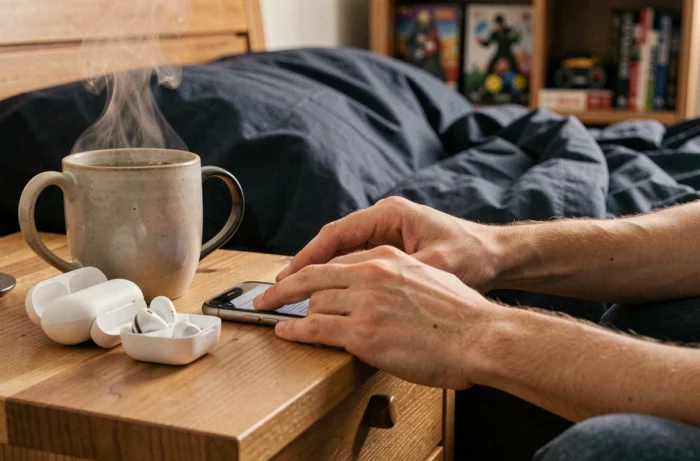
Caffeine has a half-life of five to six hours. A coffee or energy drink consumed at 6 PM retains half of its stimulating effect by midnight. For players who continue their sessions in the evening, setting a strict cutoff time for the last caffeine intake (by early afternoon at the latest) is one of the simplest and most effective adjustments.
Heavy or very sugary meals taken late also disrupt falling asleep. Opting for a light snack if hunger strikes during a night session helps avoid overloading digestion at bedtime.
Sleep Profile of Competitive Gamers: What Field Data Shows
Research conducted on e-sport players reveals a specific sleep profile: very irregular hours compared to the general population, high variability from night to night, and often insufficient total duration. This unstable pattern is associated with a measurable decline in in-game performance.
The majority of competitive players surveyed in these studies report poor sleep. The disruption does not only stem from the time spent in front of the screen but also from the irregularity of training and competition schedules, which prevents the biological clock from settling into a predictable rhythm.
For a passionate player without professional ambition, the lesson is the same: the regularity of the sleep-wake rhythm matters as much as the total duration of rest. Sleeping seven hours each night at the same time protects cognitive abilities more than sleeping five hours during the week and nine hours on Sunday.
Sleep is not a hindrance to performance in gaming. It is a technical condition for precision, decision-making, and consistency. A player who takes care of their nights progresses faster than a player who scrimps on their rest hours to squeeze in an extra game.