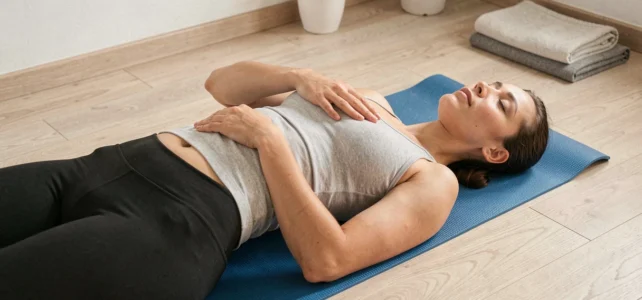
A runner who is out of breath in the last kilometers, a singer who runs out of breath at the end of a phrase, a stressed employee whose stomach is tense all day: in these three cases, the diaphragm is underperforming. This dome-shaped muscle, located between the thorax and abdomen, controls the respiratory mechanics. Strengthening it changes the quality of breath, posture, and daily stress management.
Free abdominal breathing and resistance training: two distinct practices
People often confuse abdominal breathing with actual diaphragm strengthening work. Placing hands on the belly and inflating during inhalation is a good starting point to engage the muscle. However, this gesture alone is not sufficient for strengthening.
A systematic review with meta-analysis published in 2025 in the Journal of Bodywork and Movement Therapies (Xavier DM et al.) analyzed 25 studies involving 522 athletes. The conclusion is clear: protocols for inspiratory muscle training (IMT) with quantified resistance reliably increase inspiratory and expiratory strength and improve lung function. The effect is more pronounced in football players and swimmers.
The typical protocol identified in this meta-analysis consists of about thirty inhalations against resistance, twice a day, for at least six weeks. To find exercises to strengthen the diaphragm with Com 2 Net, we have an overview that clearly distinguishes between free approaches and load-based approaches.
In practice, abdominal breathing remains a useful respiratory warm-up. It prepares the diaphragm, enhances body awareness, but does not replace progressive resistance training if the goal is performance or rehabilitation.

Diaphragm strengthening exercises without equipment: three practical methods
No need for an IMT device to start engaging the diaphragm beyond simple abdominal breathing. Three exercises stand out for their effectiveness.
Abdominal breathing with weight on the belly
Lie on your back with knees bent. Place a book or a small bag weighing a few kilos on your belly, just below the ribs. Inhale and push the weight towards the ceiling by inflating your belly. Exhale and let the weight slowly compress the abdomen.
Adding this weight transforms a mobilization exercise into real strengthening work. The diaphragm must exert more force to descend against the resistance. Aim for sets of eight to twelve slow breaths, two to three times a day.
Pursed lip breathing
Standing or sitting, inhale through the nose while inflating the belly, then exhale very slowly through the mouth, lips pursed as if blowing into a straw. The expiratory resistance forces the diaphragm to control its ascent. This technique is used in respiratory rehabilitation for patients suffering from dyspnea.
Lengthening the expiration time to double the inhalation time intensifies the work. For example, four seconds of inhalation followed by eight seconds of exhalation.
Costal opening with rotation
Sitting on a chair, keep your arms close to your body and bend your elbows at 90 degrees. During inhalation, perform an external rotation of the arms (palms facing up) while opening the thorax. On exhalation, return to a neutral position. This movement engages the diaphragm in its lateral component and mobilizes the costo-vertebral joints.
- The weight on the belly targets diaphragmatic descent against resistance, ideal for increasing inspiratory strength.
- Pursed lips work on expiratory control and the gradual ascent of the diaphragm.
- The costal rotation improves thoracic amplitude, often limited in sedentary or stressed individuals.

Diaphragm and pelvic floor: an underutilized link in practice
The mechanical link between the diaphragm and the pelvic floor is rarely discussed, even though they function as a piston. When the diaphragm descends during inhalation, the pelvic floor descends in mirror. When the diaphragm rises during exhalation, the pelvic floor rises as well.
A rigid or underused diaphragm disrupts this coordination. In perineal rehabilitation, physiotherapists now incorporate diaphragmatic breathing exercises to improve pelvic floor tone. This trend is documented in recent literature on functional rehabilitation.
In practice, one can combine a diaphragm strengthening exercise (breathing with weight) with a gentle contraction of the perineum during exhalation. This combined work enhances the stability of the abdominal cavity as a whole, benefiting both posture and the management of intra-abdominal pressures during exertion.
Scheduling your respiratory training: frequency and progression
One point confirmed by field feedback: regularity matters more than the duration of sessions. A few minutes morning and evening yield better results than a long weekly session.
- Start with simple abdominal breathing for a week to learn to isolate the diaphragm’s movement.
- Add weight on the belly in the second week, gradually increasing the weight.
- Incorporate pursed lips and costal rotation alternately in the following weeks.
- For those aiming for athletic performance, switch to an IMT device after four to six weeks of equipment-free work.
The progression of weight or duration should remain gradual. The diaphragm is a striated muscle that responds to the same adaptation principles as the biceps or quadriceps: progressive overload, recovery, regularity.
Feedback varies on the time it takes to feel a change, but most practitioners note an improvement in breath quality and a reduction in tension in the lower back after three to four weeks of daily practice. The link between the diaphragm, psoas, and quadratus lumborum partly explains this relief: a mobile diaphragm reduces tensions transmitted to the pelvis and lumbar spine.