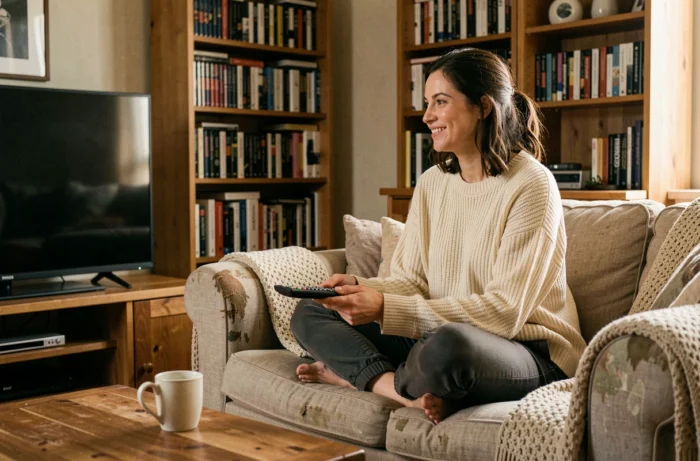
When you start an episode in the evening after a busy day, you’re rarely looking to check a cultural box. You want to unwind. The reflex has become almost automatic: in 2026, nearly half of the French turn first to a streaming platform when they actively decide to watch a series, while linear television maintains a higher daily viewing volume. This gap between the act of choice and the actual time spent in front of the screen says something about how TV series are restructuring our leisure time, far beyond mere viewing.
TV Series and Leisure Time: The Streaming Reflex Changes the Game
In practice, the distinction matters. Watching what’s on a free channel and deliberately seeking out a series on a dedicated app do not engage the same level of attention. In the first case, you endure the schedule. In the second, you create a leisure moment around a personal choice.
This shift towards the active choice of a series on a platform has concrete effects on how we organize our evenings, weekends, and commutes. We plan seasons as we would plan reading a novel: by arcs, by characters, with intentional breaks between episodes.
To explore different ways to extend this pleasure in daily life, you can check out leisure on Épisode Série, which presents the serial universe from several practical angles.
Rewatching a Series: A Leisure Activity Validated by Research
We all know someone who has watched Friends or The Office four or five times. This behavior, long seen as a waste of time, is the subject of recent analyses in psychology. Research reported in 2026 by several scientific media shows that rewatching a familiar series reduces anxiety and provides a measurable comfort effect.

The mechanism relies on what researchers call “surrogate sociality”: familiar characters act as a fictitious but stable social circle. We know what will happen, we recognize the lines, and this predictability generates a calm that novelty does not provide.
In practical terms, this means that revisiting a series is not wasted time. It is a leisure activity distinct from the first viewing, with its own benefits. We return for different reasons:
- To find a reassuring universe after a stressful period, without the cognitive effort that a new plot demands
- To spot narrative or visual details missed during the first viewing (secondary dialogues, backgrounds, foreshadowing)
- To share a series already seen with someone close who is discovering it, transforming a solitary leisure activity into a social one
Responses vary on this point according to profiles: some find the repetition tedious after the second viewing, while others draw from it an almost daily ritual.
Hands-On Activities While Watching an Episode: Combining Series and Creative Leisure
Watching a series doesn’t mean staying still. More and more people are combining viewing with a hands-on activity: knitting, drawing, puzzles, modeling. The series then becomes a narrative soundtrack that accompanies a creative gesture.
The choice of series matters. A dense plot with subtitles (the original version of a Korean or Scandinavian program, for example) requires constant visual attention. It doesn’t pair well with a hobby that occupies the hands and eyes. In contrast, a sitcom or an ensemble series with abundant dialogue works well as active background.
Some combinations that work in practice:
- Procedural series (independent episodes, little visual suspense) with crochet or embroidery
- Multi-season documentaries with coloring or journaling
- Light comedies with cooking or baking, timing the recipe steps to the duration of the episodes
This approach doubles the yield of free time. You no longer choose between watching a series and doing something with your hands: you do both.
TV Series as a Gateway to New Interests
A less obvious but very common effect: a series can trigger a hobby you would never have considered on your own. Someone watching a fiction centered on professional cooking ends up signing up for a class. A historical series sparks the desire to visit a neighborhood, read a book about the period, or join a reenactment group.
This phenomenon works because the series provides an emotional context. You don’t discover a subject through a Wikipedia page: you discover it through characters, dramatic stakes, a story. The narrative attachment lowers the barrier to entry for hobbies that might otherwise seem intimidating.

Reviews and opinions published online amplify this effect. When you read a glowing review or suggestions around a series, you often come across related recommendations: books, podcasts, exhibitions, themed outings. The series becomes a hub that redistributes attention to other forms of leisure.
We observe this mechanism with new seasons of series with a strong geographical identity. A fiction filmed in a city in France or a neighborhood in Paris generates scouting tourism, guided walks, dedicated social media accounts. The leisure spills over from the screen.
What makes TV series unique compared to other media is their duration. A movie lasts two hours. A series unfolds over weeks, sometimes years. This long timeframe allows interest to germinate, transform into regular practice, and then into an established hobby. The transition from the couch to concrete activity happens seamlessly, almost without us realizing it.