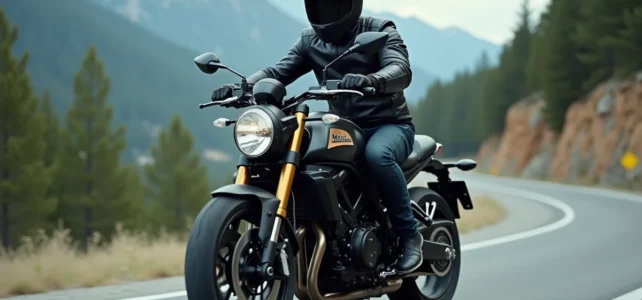
On a damp forest path, the motorcycle stalls in a rut. The rider reverses, repositions their trajectory, and sets off in first gear. This kind of situation distinguishes versatile motorcycles from machines designed solely for asphalt. The X motorcycles, built to handle the road-trail alternation without excessive compromise, meet this need for a two-wheeler capable of absorbing everything.
Weight and chassis geometry: what really changes on the trails
Engine power is often discussed when comparing dual-purpose motorcycles. In the field, it’s the weight and mass distribution that make the first difference. A heavy motorcycle with a high center of gravity becomes unmanageable as soon as the ground gives way, even with generous torque.
Recent X motorcycles utilize monocoque or semi-monocoque chassis that lower the center of gravity. This architecture allows for maintaining control in technical sections without sacrificing high-speed stability on the road. The second-generation Ducati DesertX illustrates this approach with a completely redesigned chassis around its V2 engine, where the frame directly contributes to structural rigidity.
For those looking to compare available models, Motor X Club’s X motorcycles cover a wide range of machines suited for these mixed uses. The choice of model primarily depends on the type of terrain practiced and the frequency of off-road outings.
In pure enduro, Beta offers its RR X-PRO range with displacements ranging from 125 to 480 cc, designed for trail maneuverability. At the opposite end of the spectrum, the Honda X-ADV focuses on DCT transmission and an urban-adventure crossover profile. Between these two philosophies, the choice is made based on the dominant use, not on the technical specifications.
X Motorcycles for A2 License: Mid-Displacement and Chinese Brands on the Trail
The market has shifted. In France, large-displacement motorcycles saw a sales drop of about 10% in May 2026 compared to May 2025, while the A2 and versatile 125 segments are holding up much better. There is a clear shift towards lighter and more accessible machines.
This trend directly benefits mid-displacement X motorcycles. A trail bike of 300 to 500 cc often weighs several dozen kilograms less than a maxi-trail, which radically changes behavior on the trail. Picking it up after a fall, for example, goes from a physical ordeal to a trivial gesture.
The Rise of Chinese Manufacturers
Key takeaway: one in six new motorcycles sold in France is now Chinese. CFMoto, Zontes, and Voge are gaining ground in the trail and adventure segments, with prices significantly lower than historical brands. The Zontes 125 Scrambler X, for example, offers access to the versatile segment for budget-conscious buyers.
Feedback varies on this point: the long-term reliability of these models remains to be confirmed over several seasons of intensive use. However, for mixed city-trail use without the pretense of a raid, these machines fulfill their role.
- CFMoto 1000 MT-X: upgraded and larger displacement, positioned against European and Japanese trails in the all-terrain grand touring segment
- Zontes 125 Scrambler X: entry-level accessible for A1 license, scrambler design and chassis suited for light trails
- Voge: expanded trail range with A2 models targeting entry-level Honda and Yamaha
Embedded Electronics: Off-Road Modes and Traction Control on Loose Terrain
The contribution of electronics on X motorcycles is often underestimated. On the road, ABS and traction control operate seamlessly. On trails, these same aids can become an obstacle if not recalibrated.
Off-road driving modes change the motorcycle’s behavior by simultaneously modifying throttle response, traction control intervention threshold, and sometimes ABS mapping. The DesertX 2026 incorporates modes specifically designed to allow riders to gradually learn off-road techniques, modeled after professional settings.
In practice, here’s what to check before venturing off the beaten path:
- The rear ABS must be able to be deactivated independently, to allow for wheel locking on steep descents
- The traction control should offer at least two off-road levels, one of which is very permissive for sand or mud
- The throttle response in off-road mode should be linear and progressive, without jerks at low revs
- Adjustable suspensions (rebound and compression) allow the motorcycle to be adapted to the weight of the rider loaded with luggage

Motorcycle Technical Inspection and Urban Restrictions: Anticipating Regulatory Constraints
Beyond the choice of machine, regulations increasingly impact the daily use of motorcycles. The generalization of motorcycle technical inspections is a topic of debate, with the FIM (International Motorcycling Federation) firmly opposing it. This regulatory uncertainty directly affects the resale value and maintenance costs of X motorcycles.
Another constraint to watch: low-security zones (ZSB) could restrict motorcycle circulation in cities, including those perfectly homologated. For users of X motorcycles in daily urban-suburban use, this evolution requires checking the sound and environmental compliance of their machine before any purchase.
Maintenance and Long-Term Reliability
A motorcycle regularly used on trails endures greater mechanical stresses than one used exclusively on the road. Air filters, wheel bearings, brake pads, chain kits: maintenance intervals decrease. On a mixed-use X motorcycle, revisions are generally more frequent than what the manufacturer’s manual indicates for road-only use.
The structured second-hand market is beginning to organize, with platforms like Transakmoto seeking to secure sales between individuals. For a used X motorcycle, the maintenance history and the condition of the suspensions matter more than the displayed mileage.
The versatility of X motorcycles is not limited to an attractive technical sheet. It is measured in the field, in the mud, in the rain, with luggage. The market is evolving towards lighter machines with better electronic equipment, while regulatory constraints reshape daily usage conditions. Choosing your X motorcycle is primarily about precisely defining the road-trail balance you actually practice, not the one you imagine.