
When looking to enroll a child in a leisure center, understand the waste collection calendar, or find support to start a business, the first step often involves the community of municipalities. In Corrèze, these intercommunalities structure daily life far beyond what their administrative name suggests. The department has nine intercommunalities with varied profiles, each adapting its services to the reality of its living area.
Territorial marketing in Corrèze: when a community of municipalities recruits its residents
Haute Corrèze Communauté has launched an uncommon initiative for a rural intercommunality: the creation of a territorial brand aimed at attracting new residents. The stated goal is to transform current residents into ambassadors for the territory, with a targeted communication strategy to renew the population and maintain public services in the long term.
This type of initiative goes far beyond the management of traditional competencies. It involves a process of prospecting, visual identity, and networking that resembles what some metropolitan areas do, adapted to a medium mountain territory. Feedback varies on the actual effectiveness of these measures, but the initiative reflects a growing awareness: without additional residents, maintaining a school, a daycare, or a transport line becomes arithmetically difficult.
In a similar vein, other Corrèze structures are organizing themselves. The site cc-beynat.fr allows users to directly consult the services offered by the community of municipalities of Pays de Beynat, from after-school care to urban planning.
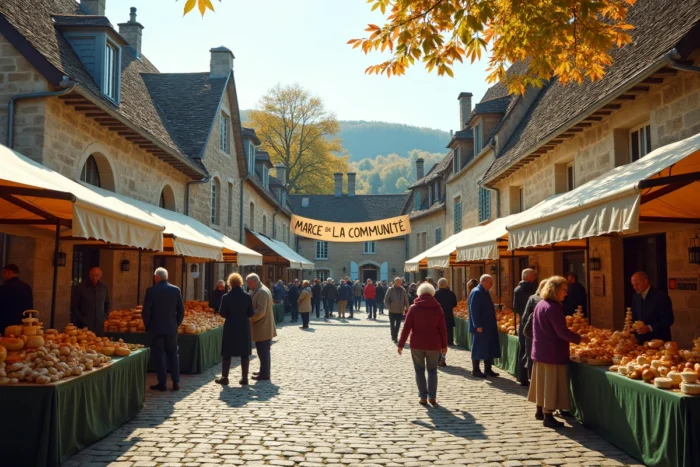
Local services in rural Corrèze: what works on a daily basis
The list of competencies exercised by a community of municipalities is long on paper. In practice, three blocks of services concentrate the actual use by residents.
Waste management and recycling centers
This is often the first concrete contact between a household and its intercommunality. In Corrèze, the communities of municipalities manage collection, sorting, and recycling centers. Collection calendars vary by hamlet, and a mistake in the day can mean a two-week wait. Intercommunal sites generally publish these schedules, but their updates are uneven from one structure to another.
Early childhood and leisure centers
The early childhood networks organized by intercommunalities offer regular workshops for childminders and parents. Leisure centers for children aged three to ten operate during school holidays and, in some cases, on Wednesdays. For families living in municipalities without municipal structures, the intercommunality is the only accessible operator within a reasonable distance.
Economic support and project leaders
Several Corrèze communities of municipalities have a support service for project leaders. Specifically, this ranges from assistance in preparing grant applications to connecting with vacant commercial spaces. For someone considering moving to Corrèze with a craft or agricultural project, this intercommunal desk is often more responsive than going through regional services.
Map of Corrèze intercommunalities: nine structures with different realities
Corrèze includes two agglomeration communities and seven communities of municipalities. The two agglomerations, Bassin de Brive and Tulle Agglo, concentrate the majority of the department’s residents. Brive-la-Gaillarde and its basin form the main urban area, with a population significantly higher than that of Tulle or Ussel.
The seven communities of municipalities cover geographically larger but less populated territories:
- Haute Corrèze Communauté encompasses a large part of the eastern department, in a medium mountain area, partially within the Millevaches Regional Natural Park in Limousin.
- Ventadour-Égletons-Monédières and Vézère-Monédières-Millesources occupy the center of the department, with challenges in maintaining services in central towns.
- Midi Corrézien, Xaintrie Val’Dordogne, Pays de Lubersac-Pompadour, and Pays d’Uzerche complete the network, each with specificities related to their proximity to the Dordogne, Lot, or Cantal.
This diversity has a direct consequence: the services available vary greatly from one intercommunality to another. A community of municipalities with a few thousand residents cannot offer the same level of facilities as an agglomeration.
Understanding public services in Corrèze: the challenge of local proximity
The Corrèze Department organizes meetings to explain how public services operate in the territory. These initiatives address a concrete need: in a rural department of nearly 280 municipalities, knowing who does what between the town hall, intercommunalities, and the department remains unclear for many residents.
The distribution of competencies is not intuitive. Urban planning may fall under the municipality or the intercommunality depending on the delegations. Drinking water and sanitation have gradually shifted to the communities of municipalities. Social services remain largely departmental, but early childhood networks are intercommunal.
For a newcomer to Corrèze, the best practice is to first identify their community of municipalities, then consult its website to locate local services. Each of the nine Corrèze structures has a reception, either physical or by phone, capable of directing inquiries to the right contact.
The intercommunal network in Corrèze is not an abstract organizational chart. It is the level where decisions are made regarding the opening of daycare centers, recycling center hours, and support for local businesses. Each community of municipalities adapts its priorities to the demographic and geographic reality of its area, making direct consultation of its website or reception essential before any steps are taken.