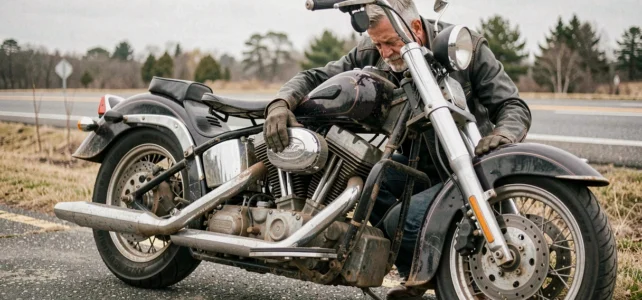
The Twin Cam 103 is not a monolithic engine. Depending on the year of production, the type of chassis it is mounted on, and the usage profile, we observe considerable differences in longevity, with some examples exceeding 150,000 km while others show weaknesses before reaching 40,000 km. Understanding these disparities requires going beyond simple user feedback to analyze recurring failure points and the subtle changes made by Harley-Davidson over the years.
Overheating and oil degradation: the real divide between generations of the 103
The early Twin Cam 103s produced before 2014 share a vulnerability not mentioned in the technical specifications: a marked sensitivity to overheating in urban use. The air-cooled system, a legacy of Harley’s philosophy, reaches its limits in prolonged traffic jams or hot climates. Excessive temperature accelerates oil degradation, erodes the rings, and weakens the head gaskets.
We recommend switching to a suitable grade synthetic oil for these model years and reducing oil change intervals compared to the manufacturer’s recommendations. The difference in behavior between a 103 maintained with conventional oil and one running on synthetic can be directly measured in oil consumption starting at 30,000 km.
The issue of the reliability of the Harley 103 engine based on user feedback consistently comes up on forums, and it is precisely this distinction between model years that is often missing from discussions. The 103 Touring models produced between 2014 and 2016 benefit from revised ECM calibrations and minor improvements to the lubrication circuit that significantly enhance durability.
Cam chain tensioner and cam followers: the parts that fail first on the Twin Cam 103
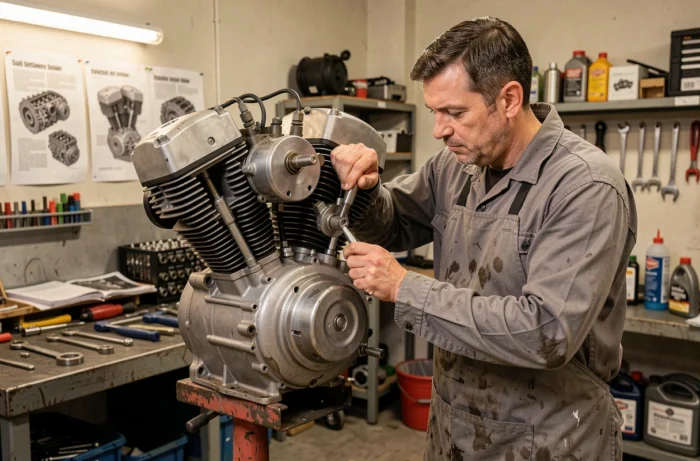
The hydraulic cam chain tensioner remains the documented Achilles’ heel of the Twin Cam 103. The original mechanism uses plastic followers that disintegrate over time. When debris migrates into the crankcase, the damage can range from simple rattling noises to the destruction of the crankshaft gear.
On specialized forums, owners report cam follower failures sometimes well before the mileage threshold expected from an engine of this displacement. Preventive replacement with a mechanical tensioner kit (gear-drive or reinforced hydraulic type) has become a nearly standard intervention within the community.
Warning signs not to ignore
- A metallic ticking at idle that diminishes as the RPM increases, often mistaken for a rocker noise, may indicate a cracked cam follower
- A noticeable play in the timing (checkable with a dial gauge) indicates chain elongation that accelerates the wear of the remaining followers
- Visible plastic particles in the oil during an oil change are a warning signal that justifies immediate intervention
Preventive replacement of the followers costs a fraction of a complete bottom-end overhaul. We consider this operation non-negotiable on any 103 exceeding average mileage, particularly on models produced before 2014.
Harley 103 engine: real reliability after Stage 1 preparation
The transition to Stage 1 (open air filter, free-flowing exhaust, ECM re-mapping) is the most common modification on the 103. The question of its impact on reliability is divisive, but feedback converges on one point: a properly mapped Stage 1 does not degrade the engine’s longevity.
The gain in low-end torque reduces engine stress on the highway, which can paradoxically decrease mechanical wear in road use. Conversely, a Stage 1 installed without re-mapping (ECM flash or external module like Power Vision) creates a lean mixture that causes cylinder head temperatures to rise and accelerates the issues mentioned earlier.
What really changes after a Stage 1
The engine breathes better, operating temperature slightly decreases under normal conditions, and the torque available from 2,500 RPM transforms city riding. Users who frequently ride on the highway report reduced oil consumption after re-mapping, confirming that the stock mapping is conservative enough to create unnecessary thermal stress at certain RPMs.
Beyond Stage 1, any further preparation (cams, increased displacement) significantly alters the reliability equation and moves away from the framework of serene daily use.
Buying a used 103: checks that advertisements do not cover
The displayed mileage is not enough to assess the actual condition of a Twin Cam 103. An engine that has primarily run on open roads at stabilized RPMs ages better than an urban engine with low mileage but subjected to repeated thermal cycles.
- Check the history of cam follower replacements: if it has never been done, budget for the intervention in the purchase cost
- Analyzing the used oil (color, consistency, presence of particles) provides more information than any sales pitch
- Check the valve clearance and the condition of the rockers, two wear points that betray neglected maintenance
- Favor the 2014-2016 Touring models, considered the most reliable of all Twin Cam 103 production
A 2015 103 with a complete maintenance history and replaced cam followers represents an excellent cost/reliability ratio in the used Harley market today. The Milwaukee-Eight engine that succeeded it corrects some structural flaws, but a well-maintained 103 remains a V-twin whose robustness is beyond question once it has passed the necessary checks.