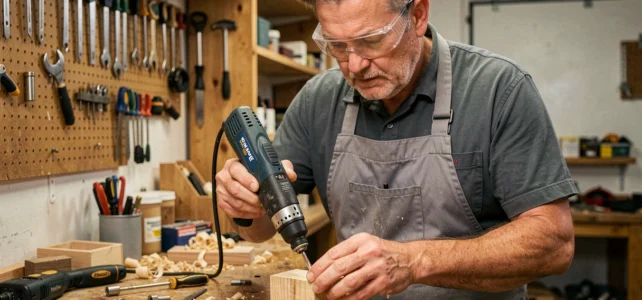
A multifunction rotary tool is used for sanding, engraving, cutting, and polishing various materials (wood, metal, plastic, ceramic) thanks to a rotating head that accepts dozens of interchangeable accessories. The choice between Dremel and Parkside, the brand distributed by Lidl, relies less on the catalog of accessories provided than on three often underestimated technical parameters: battery capacity, vibration levels under load, and motor durability beyond the first year.
Brushless motor and speed range: what really separates the two ranges
The Dremel 8240, the reference cordless model, features a brushless motor with a speed range of 5,000 to 35,000 RPM. This type of motor reduces internal friction, which limits overheating during prolonged sessions and extends the mechanical lifespan of the device.
The Parkside rotary tool sold at Lidl uses a classic brushed motor. For short passes (wood engraving, light deburring), the difference is barely noticeable. It becomes apparent as soon as the work requires constant pressure for several minutes: sanding a tile joint, cutting a copper pipe, or cleaning rust off a cast iron grill.
A Dremel Parkside comparison at Lidl details the differences in motor behavior depending on the materials worked on, allowing one to identify the threshold of demand where the Parkside reaches its limits.
Battery life: 2 Ah versus 1.3 Ah in real use
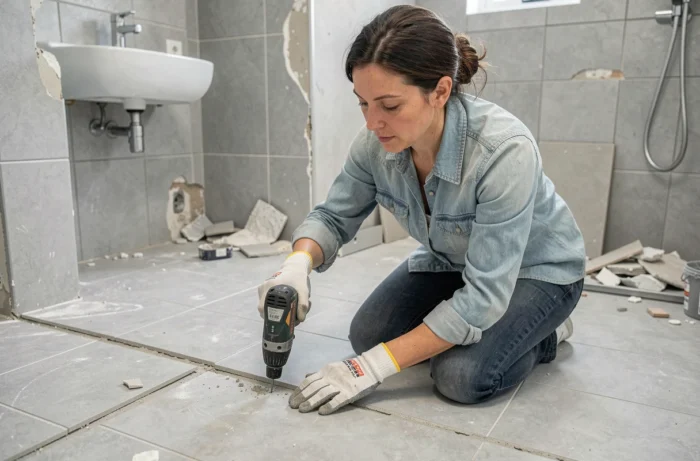
The Dremel 8240 comes with a 2 Ah battery, while the equivalent Parkside kit includes a 1.3 Ah battery. On paper, the difference seems modest. In practice, it determines the duration of an uninterrupted work session.
With 1.3 Ah and a brushed motor (which consumes more than a brushless), the Parkside lasts about twenty minutes under average load before needing a recharge. The Dremel, combining a more generous battery and a more efficient motor, regularly exceeds half an hour under the same conditions.
For a DIYer who works occasionally (touching up furniture, adjusting a hinge), this difference has no consequence. It becomes a blocking factor as soon as a project requires multiple cuts or extensive sanding. However, the Parkside is compatible with the X20V Team system from Lidl: a separately purchased higher capacity battery can partially compensate for the autonomy deficit.
Vibrations and precision: the criterion that price does not display
User feedback on the Parkside rotary tool regularly reports noticeable vibrations from the moment it is turned on, sometimes enough to make detailed engraving uncomfortable. This flaw has been documented on several successive models and is a frequent reason for returns to the store.
On a Dremel 4250 or 8240, the balancing of the rotary head and the quality of the bearings result in a significantly more stable operation. The difference is especially felt in three situations:
- Fine engraving on glass or metal, where the slightest jolt marks the piece irreversibly
- Finishing sanding on soft wood, where vibrations create micro-scratches visible after varnishing
- Precision cutting on printed circuit boards or models, which requires control to the tenth of a millimeter
For roughing, stripping, or plumbing cuts, the vibration level of the Parkside remains acceptable. The choice comes down to whether the intended work can tolerate a margin of inaccuracy or not.
Accessories, compatibility, and real cost over two years
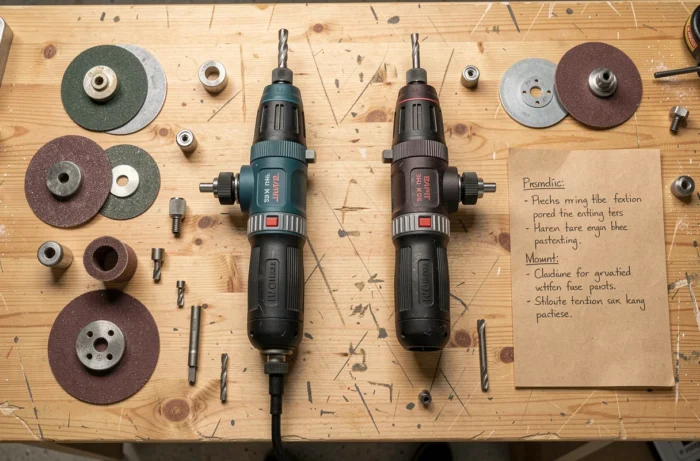
The Parkside kit sold at Lidl includes 44 accessories and five clamping jaws, a content close to the Dremel 8240 advertised with 45 accessories. Upon opening the case, the two offers seem equivalent.
The difference lies in the lifespan of consumables. The entry-level sanding discs and bits provided with the Parkside wear out faster on hard materials. The frequent replacement of these parts reduces the initial price gap.
Parkside blades comply with the universal OIS standard, allowing Bosch, Makita, or Fein accessories to be mounted on the Lidl tool. This compatibility is a real advantage, but it involves purchasing consumables that can sometimes be more expensive than the tool itself.
The entry price of the Parkside (around 18 euros for the basic rotary model) is about 116 euros less than the Dremel 8240. Over two years of regular use, the cumulative cost of replacement accessories and a potential additional battery can absorb a significant part of this gap.
After-sales service and reliability after twelve months: Lidl’s documented weak point
Customer reviews regarding Lidl’s after-sales service are often more critical of the brand than of the product. The management of returns, replacement times, and availability of spare parts concentrate most of the complaints.
Dremel, a subsidiary of the Bosch group, has a structured after-sales network with identified repair centers and parts available in the catalog for several years after a model is discontinued. For a tool used intensively, this guarantee of technical support justifies part of the additional cost.
- The Parkside is suitable for occasional use in home DIY, with a controlled budget and tolerance for autonomy limits
- The Dremel is justified whenever the work requires precision, long sessions, or reliable after-sales service
- The X20V Team compatibility of Parkside may tip the balance if the user already owns other Lidl tools on this battery platform
The Parkside rotary tool remains a good entry point to discover the multifunction tool without a heavy investment. Beyond weekly use or finishing work, the Dremel 8240 offers mechanical reliability and comfort that the Lidl price does not compensate for.