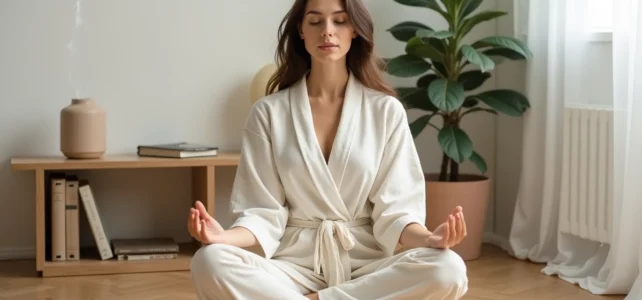
Creating a wellness space at home requires addressing three simultaneous constraints: ambient noise, air quality, and visual comfort. Typical articles focus on decoration or furniture selection. They overlook a parameter documented by the European Environment Agency in its report “Noise in Europe 2024”: repeated exposure to moderate noise in the home increases fatigue and sleep disturbances.
Noise, air, and light: a comparison of the three levers of a relaxation space at home
Before choosing a cushion or a candle, it is essential to prioritize the factors that truly influence the feeling of relaxation in a room. The table below summarizes the three main levers, their impact, and the associated simple actions.
| Lever | Impact on relaxation | Simple actions | Estimated cost |
|---|---|---|---|
| Noise reduction | Decreased chronic fatigue and sleep disturbances | Thick rugs, heavy curtains, moving the internet box and appliances away | Low to moderate |
| Indoor air quality | Reduction of headaches, better concentration | Ventilate twice a day, limit scented candles, choose low-VOC materials | None to low |
| Appropriate lighting | Regulation of circadian rhythm, feeling of calm | Warm light (below 3,000 K), dimmer switch, indirect natural light | Low |
This ranking places noise at the top because it acts continuously, even when we are not consciously aware of it. Practicing relaxation with a singing bowl on C Ma Déco loses its effectiveness if the refrigerator vibrates two meters away or if the internet box emits a constant hum.
Indoor air comes in second. Several health organizations remind us that indoor pollution can exceed outdoor levels. Volatile organic compounds (VOCs) released by certain new furniture, paints, or scented candles degrade air quality in a confined space, precisely where we seek to relax.
Sound sobriety: creating a truly quiet relaxation corner
The concept of “sound sobriety” requires no heavy investment. It is based on the idea of eliminating avoidable noise sources before adding anything to the room.
Identifying disruptive noises in the home
Try the following test: settle into the chosen room, close your eyes for two minutes, and note every sound you perceive. Refrigerator hum, computer ventilation, dishwasher vibration, phone notifications. The majority of these nuisances can be eliminated by a simple relocation or turning them off.
ANAH recommends in its 2023 wellness report very accessible measures: turning off standby devices, moving motors (fridge, dishwasher) away from the wellness space, and establishing a daily “quiet hour.”
Absorbing residual noise without renovations
Hard surfaces (tiles, polished concrete, glass) reflect sound. Soft surfaces absorb it. For a meditation or reading corner, combining a thick rug on the floor and heavy curtains at the windows significantly reduces sound reverberation.
- A dense woven wool or cotton rug placed directly under the seating dampens impact noises and creates an acoustic boundary with the rest of the room.
- Thick velvet or linen curtains that reach the floor absorb sounds from outside and reduce indoor echo.
- Bulky cushions and a well-stocked bookshelf against the shared wall add absorbing mass without any renovation work.
In contrast, decorative acoustic wall panels, often recommended online, only have a measurable effect if they cover a significant area of the wall. A single 40-centimeter square panel is more decorative than acoustic.
Indoor air quality in a relaxation space: common pitfalls
A wellness space saturated with scented candles and incense degrades the air quality it claims to purify. Combustion releases fine particles and volatile organic compounds. This paradox is rarely mentioned in traditional design guides, which systematically associate relaxation with ambient fragrance.
Two reflexes are enough to maintain healthy air in a relaxation corner:
- Ventilate the room at least twice a day for about ten minutes, even in winter, to renew the air and expel accumulated VOCs.
- Favor low-emission materials: furniture with an environmental quality label, paints rated A+ for VOC emissions, textiles made from untreated natural fibers.
- If you desire an olfactory ambiance, opt for a cold diffuser for essential oils rather than incense or candles, as there is no combustion and therefore no fine particles.
Furniture and layout: what truly changes the relaxation experience
Once noise is reduced and air purified, furniture becomes the third lever. A common mistake is to accumulate “zen” objects (fountain, statuettes, string lights) at the expense of free space.
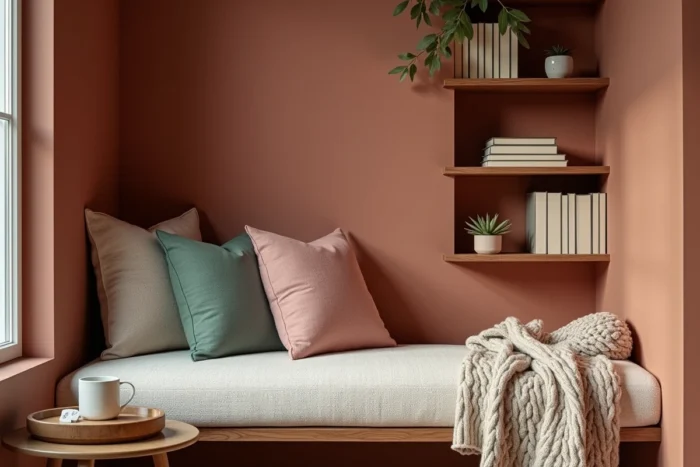
An effective relaxation corner contains fewer pieces of furniture than a typical living room. Visual clutter generates cognitive load that directly opposes relaxation. A comfortable armchair, a rug, a source of warm light, and possibly a reading or meditation support cover all needs.
Lighting as an adjustable variable
Indirect natural light remains the best option during the day. In the evening, warm light below 3,000 kelvins promotes melatonin production and prepares the body for rest. A dimmer switch on a table lamp costs a few euros and transforms the ambiance of a reading or meditation corner.
Cold spectrum LED lights, common in desk lamps, have the opposite effect: they stimulate wakefulness and disrupt the circadian rhythm. Placing a white desk lamp in a relaxation space negates some of the acoustic and decorative efforts.
Choosing the location based on usage
A space intended for meditation or yoga requires a clear and stable floor. A reading corner needs good natural lighting and a chair with proper lumbar support. Usage determines the location, not the other way around.
Installing a yoga mat in a narrow hallway or a reading chair in a room without windows compromises the entire project. One does not select “the prettiest available room,” but the one whose physical characteristics match the intended activity.
A corner of a bedroom far from the entrance and living room is better suited than a bright veranda exposed to street noise.
Ultimately, designing a relaxation space at home relies more on subtraction than addition. Reduce noise, limit air pollutants, simplify furniture. The last point to check before considering the space complete: sit there for five minutes with your eyes closed and note what you hear, what you feel, and what you sense. If any of these three channels sends a disruptive signal, that is where intervention is needed.