You have just purchased a gas stove, and at the time of connection, a doubt arises: do the injectors supplied with the device correspond to your gas supply? This is a concrete question because an injector designed for natural gas does not allow the same flow rate as one intended for butane or propane. Making a mistake means getting a flame that is too high, too low, or incomplete combustion that produces carbon monoxide.
Gas pressure and injector diameter: the technical link to understand
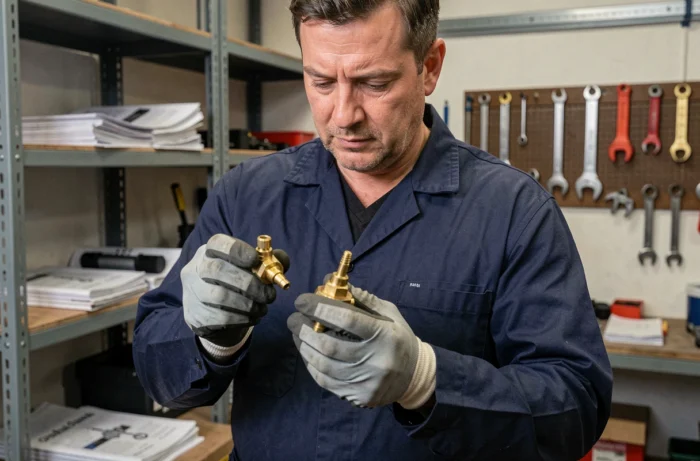
An injector is a small brass piece with a calibrated hole. The gas passes through this hole before reaching the burner. Everything depends on the diameter of this opening, measured in hundredths of a millimeter.
Why do two types of gas require two different injectors? The answer lies in the distribution pressure. Natural gas (town gas, category G20) arrives at a lower pressure than bottled gas. Therefore, it needs a wider opening to provide enough flow. Butane and propane, distributed under higher pressure, require a narrower opening to avoid releasing too much gas at once.
Specifically, for the same rapid burner, the natural gas injector has a significantly larger diameter than that for LPG. For example, a rapid burner can receive an injector marked 129 for town gas and only 87 for bottled gas, according to manufacturer tables. This mark corresponds to the diameter in hundredths of a millimeter.
To check the correspondence between town gas and bottled gas injectors suitable for each burner, the device’s manual remains the reference. It contains a table of injectors that associates each burner (auxiliary, semi-rapid, rapid, oven) with the injector mark according to the type of gas.
Injector G20, G30 or G31: identify the correct code on your device
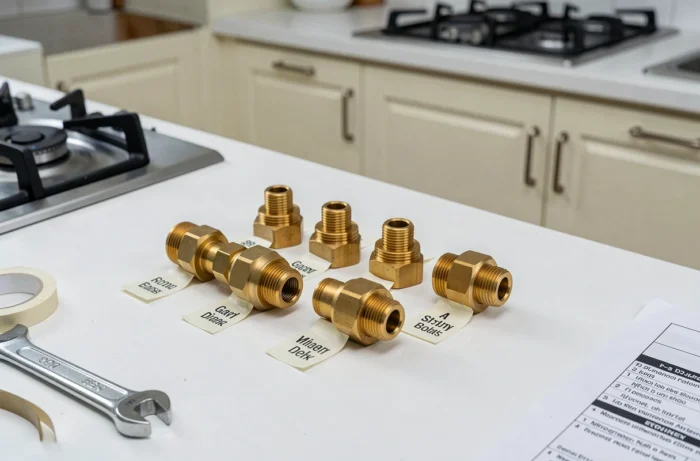
The codes G20, G30, and G31 designate standardized gas categories. G20 corresponds to natural gas distributed by the town network. G30 designates butane and G31 propane, both sold in bottles or tanks.
On the nameplate of your stove or cooktop, you will find the mention of the compatible gas or gases. A device delivered “all categories” is often factory-equipped for natural gas G20. The conversion kit for G30/G31 can be found in a bag attached to the back or underneath the device.
Butane or propane: same injector or not?
Butane and propane often use the same injectors because their marks are identical in most manufacturer tables. The difference lies elsewhere: at the regulator level. According to the NF EN 16129 standard, the butane regulator delivers 28 mbar and the propane regulator 37 mbar.
An unsuitable regulator alters the supply pressure. Even with the correct injector, a propane regulator on a butane bottle (or vice versa) degrades combustion. Yellow flame, soot on pots, unusual odor: these are signs of a poor regulator-injector pairing.
- Butane (G30): indoor use, pressure relief of 28 mbar, bottle stored in a ventilated area at positive temperature.
- Propane (G31): usable outdoors even in cold weather, pressure relief of 37 mbar, bottle or tank must be stored outside.
- Natural gas (G20): connection to the town network, pressure regulated upstream by the distributor, no regulator on the user side for cooking.
Changing the injector when moving or changing gas
The most common case: you move from a home connected to town gas to a home supplied by a bottle, or vice versa. You will then need to replace each injector, burner by burner, and adjust the slow-down screw of each tap.
The concrete steps for replacement
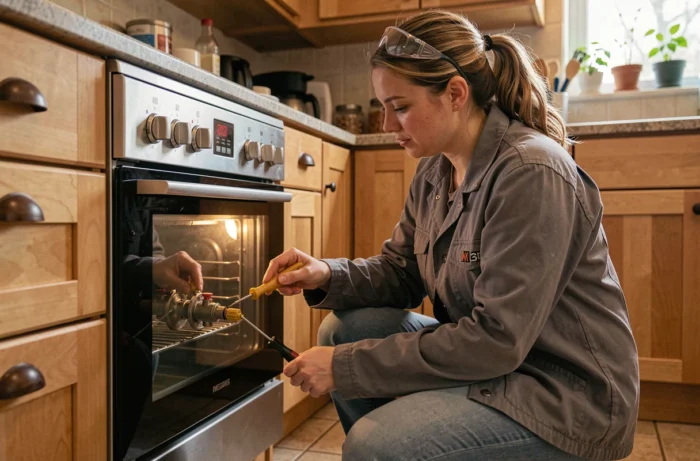
Start by turning off the gas supply and unplugging the device. Next, you need to remove the grates, burner caps, and the burners themselves to access the injectors screwed into the burner body. A tube wrench of the right size allows you to unscrew the injector in place, then screw in the new one without forcing.
Each injector has a number engraved that indicates its diameter. You can read it with a magnifying glass or by tilting the piece under the light. This number must exactly match the one indicated in the manual’s table for the intended gas type and the relevant burner.
After replacement, adjusting the slow-down is a step that many forget. Each gas tap has a small screw (sometimes accessible through a side hole) that determines the minimum flow rate. A poorly adjusted slow-down can cause the flame to go out in the minimum position, or conversely, a flame that is too strong that prevents simmering.
Safety and compliance: what regulations require
Since January 1, 2026, gas installations created or modified in buildings receiving the public (ERP) must undergo a systematic verification of the adequacy between the type of gas, service pressure, and adjustment devices (injectors, regulators, valves). For domestic use, there is no legal obligation to hire a professional to change injectors. In practice, it is still recommended if you are not comfortable with gas connections.
- After each injector change, test the tightness of the connection with soapy water applied to the joints. Bubbles indicate a leak.
- Never use an injector whose mark does not appear in the device manual, even if it seems to “fit” into the threading.
- Keep the old injectors in the original bag: in case of a new move, they will be useful again.
The choice of injector is not a trivial detail. It is the point of intersection between the pressure of your supply, the flow needed for each burner, and the quality of combustion. Taking five minutes to check the manual and the number engraved on each injector avoids a poorly calibrated flame and the risks that come with it.